
Shopping for an ASIC? How the Miner Ranking Page Sorts Hype From Output
A buyer comparing machines needs one honest yardstick: daily coins per terahash at current difficulty. At the 21 September inputs a 126 TH/s unit grosses $4.79 a day and keeps about $4.60 after the listed 4% on the block-reward component. This guide shows how to read a profitability ranking the way a second-hand dealer reads an odometer.
Key takeaways
- A 126 TH/s machine earns 5.652e-05 BTC a day ($4.79 gross, $4.60 net) at network 1,003 EH/s and BTC $84,692.
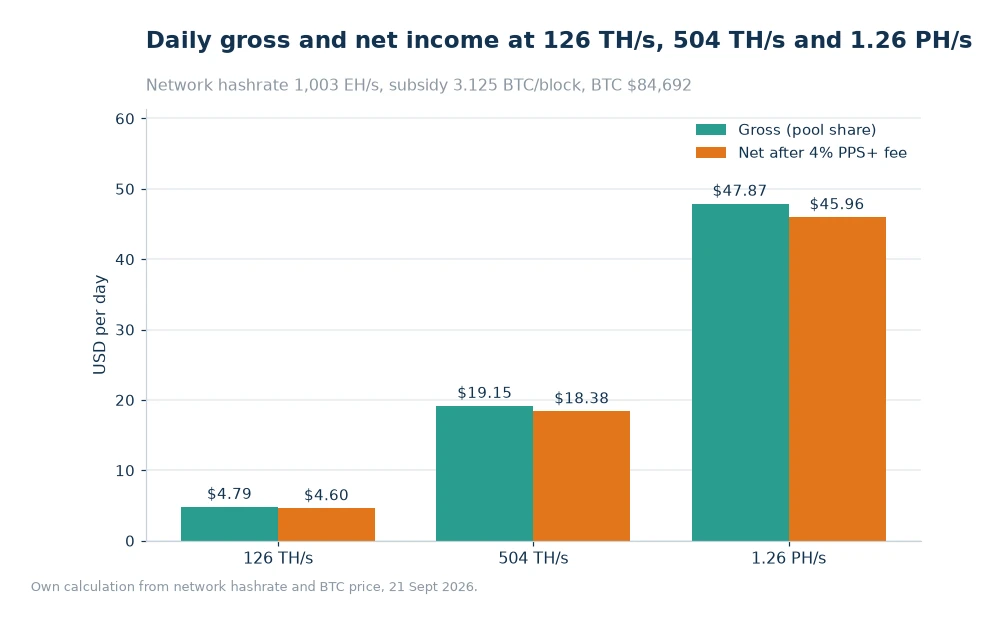
- Four such machines (504 TH/s) gross $19.15 and net $18.38; ten (1.26 PH/s) gross $47.87 and net $45.96.
- Rankings sort by live coin price and difficulty, so a model at the top in September can slide by winter.
- Efficiency in joules per terahash decides the winner whenever two models hash the same.
Start with the odometer, not the badge
Used-rig listings all shout the same adjectives, so ignore them and look for three figures: advertised hashrate, wall power draw, and hours already run. A seller who cannot state all three is selling a surprise. The ranking page then converts the first two into money at today's difficulty of 132.76 T and today's network of about 1,003 EH/s, which strips the adjectives away. What remains is a ranked column of daily dollar estimates, each one recomputed from the 450 BTC the chain issues every 24 hours.
The 126 TH/s entry in the chart stands in for a typical single purchase: one efficient box, fresh from a dealer or refurbished with new fans. Its gross of $4.79 comes straight from its network slice, 126 divided by 1,003,000,000 times 450 BTC, converted at $84,692. No ranking can improve that slice. The page only reports it, updates it when difficulty moves, and lets the buyer compare it against the asking price.
Reading a ranking row like a dealer
Each row on a profitability ranking hides four judgments. First comes raw output, the daily gross at current difficulty. Second comes the pool deduction, the listed 4% on the PPS-settled block-reward slice under the default PPS+ path, which trims the 126 TH/s gross from $4.79 to $4.60. Third comes power cost, which the page cannot know because it never sees your tariff. Fourth comes the machine's age, visible as falling efficiency against newer models. A buyer who checks all four never overpays for a shiny case.
The ViaBTC Miner Ranking exists to keep the first judgment current, recalculating each model's standing as price and difficulty drift. Difficulty even arrived with a projected dip near 2.12% at the September read, a reminder that yesterday's ranking order is not a promise. Dealers who screenshot a ranking from July and present it as today's truth are hoping you will not notice the date.
Physical inspection separates honest listings from polished ones. Ask for a video of the unit hashing at its advertised rate with the camera panning across the dashboard, the power supply rating plate and the exhaust stream. Listen for rattling fans, look for swollen capacitors and dust packed between heatsink fins, and check that all hash boards report rather than two of three. A seller who refuses any of this is pricing your trust at zero, so walk away. Refurbished boards can run for years, but only when the refurbishment actually happened.
Warranty and power supply paperwork close the deal or kill it. Factory warranties rarely transfer to second owners, while dealer warranties vary from genuine bench repair to a disconnected phone number. Get the term in writing with a return address, confirm which power supply revision ships with the unit, and budget a spare fan set regardless of promises. Nineteen cents of daily pool fee never sank a purchase; a dead power supply with no warranty did, repeatedly, across every marketplace.
Joules per terahash decide close contests
Two boxes can both print 126 TH/s while drawing wildly different power. One sips near 20 joules per terahash and the other gulps 30, and over a month that gap dwarfs any pool fee. At six cents per kWh, the thirstier box burns roughly an extra dollar a day for the same $4.79 gross. Multiply by a year and the efficient machine earns its price premium twice over. Rankings that display efficiency beside output are worth more than rankings that show dollars alone.
This is where the listed pool fee details belong in perspective. Nineteen cents a day on the 126 TH/s unit is real money, yet it is smaller than the power gap between a good and a mediocre design. Buyers who haggle over fractions of a fee percent while ignoring a 500-watt difference in the spec sheet are negotiating the wrong line. Settle efficiency first, then let the fee schedule confirm the net.
From one box to a small fleet
The chart stretches the same unit to fleet sizes because most buyers do the same math within a year. Four boxes at 504 TH/s gross $19.15 and net $18.38; ten boxes at 1.26 PH/s gross $47.87 and net $45.96. The line is straight because the chain pays proportionally: double the slice, double the coins. Nothing about joining a 150-country pool with over a million users bends that line. Scale changes the power bill, the noise, and the electrician's invoice, never the per-terahash rate.
A short rule of thumb keeps fleet dreams honest. Price the machines, add delivery and breakers, then divide by the daily net at your tariff to get a payback horizon in days. If that horizon outlives the model's competitive life at rising difficulty, buy fewer boxes or newer ones. The mining returns estimator will run the same division with your own power figure instead of a catalogue fantasy.
| Shortlist pick | Daily gross | Daily net | Why it fits a buyer |
|---|---|---|---|
| Single unit, 126 TH/s | $4.79 | $4.60 | Cheapest ticket to measured reality |
| Four units, 504 TH/s | $19.15 | $18.38 | Tests power and noise before big spend |
| Ten units, 1.26 PH/s | $47.87 | $45.96 | Fleet maths; needs dedicated feed |
Notice how the rightmost column carries no numbers. Fit is qualitative: a single unit teaches monitoring and heat habits, four units test whether the building copes, ten units demand an electrician and a plan. Buyers who skip the middle step often discover their wiring limits at the worst moment, with ten boxes humming and one breaker glowing.
Worked example
Rebuild the 126 TH/s bar from chain inputs, then extend it to the fleet bars.
- Daily BTC per TH/s: 450 ÷ 1,003,000,000 = 0.00000044865 BTC.
- 126 TH/s coins: 126 × 0.00000044865 = 0.00005652 BTC, shown as 5.652e-05 BTC.
- Gross dollars: 0.00005652 × 84,692 = $4.79.
- Net after the listed 4% on the block-reward component: $4.79 × 0.96 = $4.60.
- 504 TH/s is four times larger: 0.00022609 BTC a day, $19.15 gross, $18.38 net.
- 1.26 PH/s equals 1,260 TH/s: 1,260 × 0.00000044865 = 0.00056524 BTC, $47.87 gross, $45.96 net.
- Power cross-check: a 126 TH/s box at 25 J/TH draws about 3.15 kW, near 75.6 kWh a day, so tariff decides the margin.
Frequently asked questions
Which number on a ranking matters most?
Daily net per terahash at your tariff matters most, because the $4.60 net on a 126 TH/s box already assumes the listed 4% while your power cost is still unknown to the page.
How often should I recheck a model before buying?
Recheck on the day money moves, since difficulty at 132.76 T and BTC at $84,692 can both shift within weeks and reorder every row of the ranking.
Is a bigger hashrate always the better deal?
No. A 1.26 PH/s fleet nets $45.96 a day only with power and cooling to match, while an efficient single 126 TH/s unit at cheap power can pay back sooner.
Buy the meter reading, not the brochure
Ask the seller for a photo of the miner's dashboard beside a clamp meter, then compare that draw against the ranking's dollar row. If the $4.60 net survives your tariff with margin to spare, the deal is real. If it survives only at free power, keep walking. Rankings report the chain; meters report the truth.
Sources: miner ranking and fee pages for model ordering and the listed 4% on the PPS-settled block reward; chain inputs read 21 Sept 2026 (network about 1,003 EH/s, difficulty 132.76 T, subsidy 3.125 BTC, 144 blocks a day, BTC $84,692); published 11 Nov 2026. Figures are arithmetic on those inputs[1].